Cover 2 Man — How to Beat It
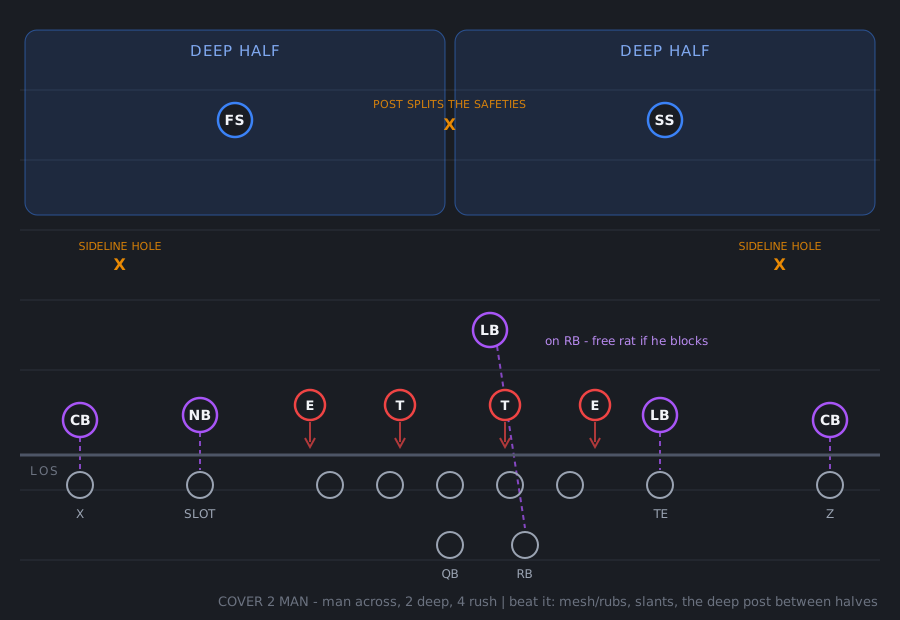
How to identify it
- Two high safeties splitting the field.
- Corners pressed down at 2–3 yards with inside leverage — cover 2 man wants to funnel outside releases; that inside shade under a two-high shell is the giveaway (zone cover 2 corners sit ~5 yards off).
- Motion confirms it: a defender travels across with the motion man.
- Everyone but the two safeties is manned up or rushing.
Start here: they just gave you the run
Before you look for a route concept, count. Two safeties are parked deep, which means the box is light and you have a blocker for every defender in it. Against press man your receivers also take a long time to separate — a 70-overall offense running stick concepts against a 90-overall defense gets sacked waiting for somebody to come open.
So run it. Four ways, in rough order of how much they add:
- Hand it off. Six blockers against six box defenders is an even count, and even counts are good counts.
- Read option. Adding the quarterback as a runner makes it six-on-five — the unblocked edge defender is read instead of blocked.
- Scramble. Call a pass and take the grass when the lanes open; in man, every defender's back is turned.
- QB draw off pass action (the "QB draw stick" family). Five receivers release, both safeties are deep, and nobody in the coverage is assigned to the quarterback. It is the cleanest version of the same idea.
The honest limit: if the defense has a genuinely strong front, this gets stuffed, and two bad runs leave you in third-and-11 with nothing gained. The run is the first answer, not the only one.
Rub and crossing concepts
When you have to throw, the principle is traffic. They rub, they don't pick — the game won't let defenders be blocked, but it will absolutely let them run into each other, trip, and fall. On film an 89-overall corner goes down on a clean rub and leaves his man wide open.
Two things make it happen more often:
- Motion the crossing receiver. The cover man then has to work under or through up to four bodies to stay attached. This is the single biggest multiplier on the whole family.
- Clear the underneath space first. Push your checkdown out to the flat pre-snap so the crosser has somewhere to arrive.
Throw on the break. The separation isn't sustained — it's a burst right as the receiver clears the cut. Let it develop, then release as he breaks. Wait a beat past that and the defender is reattached.
Concepts in this family that work: Motion Cross Z Drive, Cheat Slot Cross, shallow cross, slot cross, scissors, Texas.
Mesh, and when it fails
Mesh is the famous answer and it does work — the drags rub, the window opens, you take the yards.
But mesh has a real failure mode, and it is worth knowing before you build a game plan on it: sometimes your own two crossers collide with each other instead of with the defenders. One is supposed to go high and one low; when they don't, both routes die, the ball comes out late, and you eat the down. Mesh Traffic — the version designed to free the back — has the same problem: occasionally nobody comes off clean.
Treat mesh as a good call, not a reliable one. Against a strong defense it is the concept most likely to let you down.
The trail concept — the one to look for
If you want a single play to carry you against Cover 2 Man, make it trail.
It is technically in the rub/crossing family, but it behaves better than the rest of it — preferred on film over mesh, drive, deep cross and ordinary rub concepts. The reason is that the trail route forces a linebacker or underneath defender to carry a route across traffic in a way that's unnatural for him, and the concept keeps producing that even when the individual rub doesn't land.
How to run it:
- Release the back to the flat. Same principle as above — it clears the space the trail route is about to occupy.
- Read B (the trail) first. That's the primary, and the traffic usually gets him open.
- If they overplay B, A comes open. You will almost always have one of the two.
It shows up as Y Trail, Wide Trail, Fullback Trail Cross, and bunch trail variants. It lives naturally in bunch sets, which already stress man coverage — but it is not a gun-only concept. The same route is in pistol, flexbone, strong and empty personnel groupings.
Quick game: legal picks
Setup (pre-snap):
- Call double slants — two slants stacked on one side.
- Add a backside RB release if you can.
The read, in order:
- Don't throw on a one-two rhythm — let the routes develop.
- Watch the intersection points where a cover man gets rubbed off his receiver, and throw that slant.
- First read is usually the slot slant after he crosses the underneath traffic (inside-leverage corners slow outside releases).
- Checkdowns: flats, TE, RB.
Check your matchups
- At the line, hold LT and push right on the right stick — the pop-up shows WR-vs-CB matchups.
- Throw at green.
- Prioritize acceleration and change-of-direction (not just speed) — those are the ratings that matter for these short man-beaters.
- Scout the opposing corners and target the stiff ones, including the slot defender.
Deep posts are the trap: both half safeties cap them — don't force it. Play action is amplified — everything is one-on-one, so one false step wins.
Third-and-long: HB slip screen
Why it works: everyone in man bails deep with his receiver, so the screen gets 3–4 blockers on ~1 defender.
- Call the HB slip screen.
- Run it to the field (wide) side with an average back.
- Run it to the boundary side only with a burner.
Alternative setup (GetLiveMar)
- Put two corner routes on the same side — they pull both DBs wide.
- Send a streak up the vacated seam — it's open for the score.
- Need a free completion? The RB Texas route on a linebacker wins whenever you need it.
Finding these plays in your own playbook
You don't need a specific team's book — these concepts are spread across almost all of them. In the play-call screen:
- Go to play type → concept → medium pass.
- Look for trail, mesh, slot cross, scissors, Texas, motion cross.
Searching a playbook database for "trail" will show you how many formations carry it; in practice you will find a version in whatever personnel grouping you already like.
Checklist
- Count the box first. Two deep safeties means the run is on the table — take it before you get cute.
- Add the quarterback (read option or QB draw) — nobody is assigned to him.
- Motion your crossers. Traffic is the whole point.
- Throw on the break, not after it.
- Trail over mesh when you need it to work.
- Don't force the deep post — that's what the two safeties are there for.
EA patches this game every week or two, and when they do, “Cover 2 Man — How to Beat It” gets re-cut. Get a note when that happens. No spam, no other mail, one click to stop.
55 more articles are members-only — the schemes, counters and macros, re-cut after every patch. What members are reading right now: